Part 21
The morning after the retrieval my phone rings unusually early – earlier than most college students are up, so I know it’s not a work call. The second giveaway – it’s an Indy number.
I answer, “Hello.”
“Hi Jessica, this is Mary Ellen from Dr. Boldt’s office.”
OH! I almost forgot, we get a daily update on our eggs while they are in the various stages of fertilization and maturation.
“Hi, Mary Ellen. How are you?” I say.
“I’m good thanks for asking. I have an update about your eggs that we retrieved yesterday. Is now a good time?”
As if I was going to say no, but I oblige and say, “Now’s great.”
“Well, we fertilized 4 of the 5 eggs yesterday. One of the eggs wasn’t quite mature so we are going to wait until this afternoon to see if it matures a little bit more then attempt to fertilize. Of the 4 we did ICSI (inter-cytoplasmic sperm injection) – essentially injecting the sperm into the egg as opposed to putting sperm in the specimen dish with the egg and “hope” nature takes it’s course – 3 of those eggs fertilized. Unfortunately one of the eggs didn’t fertilize at all.”
All of this egg fertilization stuff is probably the most confusing. Cells dividing, ICSI, fertilize, mature, 3 days, 5 days. I’m confused.
I ask, “Okay, so we for sure right now have 3 fertilized eggs and you’ll try to fertilize the last one this afternoon. What’s the likelihood of that working?”
“I’ve seen it work and I’ve seen it not work. It could honestly go either way. Sometimes the eggs weren’t quite developed in the ovarian follicle before Dr. Carnovale aspirates them, so we leave them in the specimen dish to see if they will mature up after aspirated. It’s probably 50/50. Dr. Boldt or I will call you tomorrow morning with another update. Until then, try not to think about it.”
Try not to think about it? Easier said than done. I roll over in bed and tell Ben the news. After I fill him in he says, “Hey 3 is better than none. We’ll hold out hope – and keep reminding ourselves that all we need is – One Good Egg.” I know he’s right, so I try to go on with my day as usual and not think too much about it.
The day flies by and the next thing I know I am waking up on Friday morning to my phone ringing at another unusually early hour. It’s Dr. Boldt’s office, so I answer right away.
“Hello.”
“Hi Jessica. It’s Dr. Boldt.”
“Hi Dr. Boldt, how are you?”
“I’m good. I have an update on your embryos.”
My heart is racing. Now is when we will really see if they are maturing as embryos. No maturation (or cell division) – no live embryo to implant.
“Okay.”
 |
| Healthy Cell Division of an Embryo |
“Well the 5th egg Mary Ellen was waiting to mature yesterday afternoon, we tried to fertilize it and it didn’t fertilize. It’s a 50/50 shot and a lot of times they just don’t mature enough to successfully fertilize. As for the 3 that did fertilize: one egg has not divided the way we’d like it to. At this point we would expect it to be divided into 4 or 6 cells. That leaves us with two fertilized eggs. They are dividing, but they look really fragmented. I’ve recommended that with two embryos left that we implant tomorrow.”
Again, all this embryo stuff is so confusing. So I ask, “So what does it mean for our likelihood of having a pregnancy with one of these “fragmented” embryos.”
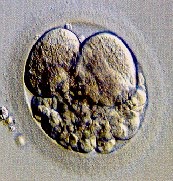 |
| Fragmented Cell Division |
Dr. Boldt responds with sincere compassion and honesty – which I love about him, “I’ve seen many women get pregnant from an embryo that looks like these – and many that have not. The body and nature is funny. I know you probably don’t want to hear this, but it could honestly go either way at this point.”
I ask again, “What would cause an egg to fragment instead of dividing as expected?”
Dr. Boldt responds, “Most likely egg quality. You’re 32 Jessica and with all your complications and surgeries, your egg quality isn’t ideal. It’s likely that it’s a poor quality egg. Don’t over think it. Let’s just implant the embryos and see what happens. Sarah or Amy from Dr. Carnovale’s office will contact you with instructions for tomorrow. We have you scheduled for 8:30 a.m. I’ll see you tomorrow morning, bright and early.”
I hang up the phone and try my best to communicate what Dr. Boldt just told me to Ben, but I feel heartbroken and hopeful. I’m sad, yet excited. I just hope implantation goes well tomorrow. I’ll be glad to have it all over with. I’m sad that we are at the point where we HAVE to implant – that we don’t have a choice of the very best embryos – we’re left with what we’ve got. I’m hopeful that it will work. I’m skeptical that it won’t. I’m sad that we didn’t have better results. I’m happy we still have 2 fertilized eggs. I am, at this point, the textbook example of “mixed emotions”. I am a ball of excitement and nervous energy at the same time I want to break down and cry.
Amy calls later that day with lots of instructions. The implant process is very different. They do them early in the morning while the OR is still quiet. Their goal is to keep you calm and relaxed. The procedure is done with the lights off. Ben’s in the room (they think it’s pretty important that the spouse is in the room when the “magic” happens (aka the embryo is implanted into the uterus). There’s no drugs or incisions. You lay on a table inverted with legs and pelvis angled up to the ceiling and your head down to the floor. Once the embryos are implanted, you lay there, inverted for 30 to 60 minutes. After that you leave with instructions for bed rest for 48 hours and to take it VERY easy for 2 weeks. No heavy lifting (actually no lifting anything over 5 pounds). No pushing. No pulling. No nothing.
Ben and I arrive early on Saturday morning, about 7:15, to check in. They quickly take us back to a dark room where we are greeted by Amy from Dr. Carnovale’s office. Everyone is speaking in hushed tones today, which is kinda funny and kinda creepy at the same time. Dr. Boldt quickly comes in and shows us actual pictures of the two embryos he’s implanting. They look pretty fragmented – and Dr. Boldt says that – but then he also says, “but I’ve seen worse embryos turn into babies.” After that I sign a form that says, “yes you can put those in me” then take a Vallium ( to help you relax and help your uterus relax), and drink and un-Godly amount of water.
After looking at the pictures, I’m wondering why we are implanting them at all. They’re both really fragmented. I don’t feel optimistic about it at all. I can feel myself losing hope.
The doctor needs your bladder super full for the procedure. They use an ultrasound on the outside of your belly to visualize your uterus and position the catheter in just right spot before Dr. Boldt injects the embryos. Dr. Carnovale stops in every once and awhile to check, using the ultrasound, to see if my bladder is full enough. Every time I am told to keep drinking water. There’s honestly no better feeling in the world than someone pushing on a VERY full bladder. It’s awesome (*sarcasm*).
Finally, Dr. Carnovale believes that my bladder is in a good spot. They start preparing for implant. Dr. Boldt wheels in a large incubator where the eggs are sitting under red heating lights on little pedestals in two separate dishes. I feel like I just ordered up room service in a fancy hotel, like Dr. Boldt is going to carve me up some delicious prime rib. As they insert the catheter, they invert the table. Dr. Carnovale starts getting the catheter and ultrasound in just the right spot – he’s a perfectionist – but he seem’s to be having trouble getting a good look at my uterus and finding the “perfect spot”.
It takes him about 5 minutes and then he says, “Okay Jessica. Here it goes.”
Just like that the embryos are in. Dr. Carnovale moves my legs out of the stirrups and onto the table. He says, “Keep your legs just like that.” Then him, Dr. Boldt, and Amy leave the room and shut the door. I’m told just lay here are relax for about 30 minutes. Don’t move.
They walk out and I look at Ben and say, “One Good Egg.”
He looks down at my awkwardly inverted head and says, “One Good Egg.”
 This is Our Fate